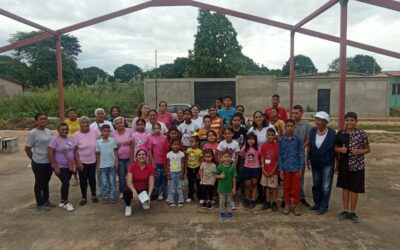
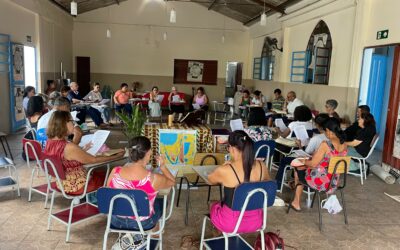
On July 25, the Pastoral and Psychology teams held a training session for teachers on the principles and steps of Nonviolent Communication (NVC). It was an enriching gathering that combined opportunities for fellowship during coffee breaks and lunch, a moment of spirituality inspired by Jesus’ encounter with the Samaritan woman, highlighting the importance of dialogue as a path to transformation, a theatrical performance, and a theoretical and practical presentation of the methodology, developed through various participatory activities.
Nonviolent Communication is a communication model developed by American psychologist Marshall B. Rosenberg, author of the book *Nonviolent Communication: A Language of Life* (2006). This approach aims to foster more empathetic, respectful, and constructive relationships through four fundamental steps: observing without judging, acknowledging feelings, identifying needs, and making clear requests.
Observation. This involves distinguishing between observation and evaluation. When we mix facts with our judgments or interpretations, people often perceive them as criticism and react defensively. Therefore, it is important to describe situations objectively, concretely, and within a specific time and context.
Feelings. It invites us to recognize and express our own feelings. Developing a vocabulary that allows us to clearly identify our emotions fosters more authentic communication and a deeper connection with others. When we show vulnerability by expressing what we feel, we make it easier to resolve conflicts. NVC distinguishes genuine feelings from expressions that actually reflect thoughts, judgments, or interpretations.
Needs. It involves identifying the needs that lie behind our feelings. What other people say or do may be a trigger, but it is not the cause of our emotions. When someone receives criticism, they often focus their energy on defending themselves or fighting back. Instead, the more we are able to connect our feelings to our needs, the greater the chances that others will respond with understanding and in an assertive manner.
Request. This refers to clearly expressing what we wish to ask for in order to enrich the relationship and promote mutual well-being. The goal is to avoid vague, ambiguous, or negative expressions by making specific requests using positive language. The more specific the request and the clearer the response we expect, the greater the chances of being understood.
During the session, the example of Saint Joaquina de Vedruna was also presented, analyzing the way she communicated with people through her letters (LettersNos. 41 and 97). In these letters, we discover that, rather than focusing solely on the manner of communication, Joaquina knew how to distinguish the person from their behavior. Even when she had to correct a sister or deal with difficult situations, she always sought to preserve their dignity.
Joaquina deeply valued dialogue and discernment. In her letters, she sincerely expressed her joys, concerns, hopes, and sufferings, placing everything in God’s hands. Faced with people’s needs, she sought to welcome them, mediate in conflicts, and offer help to the best of her ability. When making requests, she exercised authority with love, dialogue, and trust, inspiring others through her witness rather than through imposition.
Saint Joaquina teaches us that good communication stems from love, listening, and respect for others. Her example invites us to cultivate dialogue with empathy, to embrace differences, and to build, day by day, relationships that are more humane, fraternal, and in keeping with the Gospel.
Sister Maria Júlia da Conceição Souza, CCV