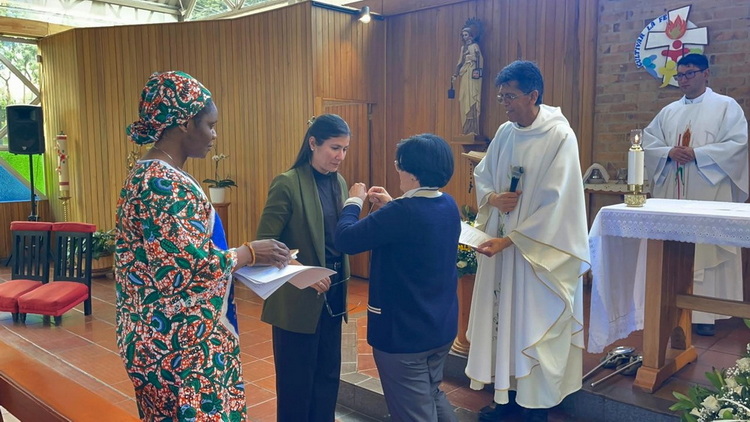
Gabrielle Muntukwaku, ccv (first from the left), is the coordinator of the Kekeli Center in Togo, which provides shelter for girls, boys, and adolescents rescued from human trafficking and sexual violence. We spoke with her during her participation in the UISG Advocacy Forum 2023, held in Rome on October 23 and 24, which brought together religious and lay members of the international Talitha Kum network.
Describe the reality of human trafficking in the area where you work.
In our experience, human trafficking and economic exploitation have now become visible in both
urban and rural areas. When it comes to economic exploitation, many children—mostly girls (aged 6 to 18)—work all day as domestic workers or as street vendors or at fixed stalls selling products provided by their guardians or employers in the markets.
How do you identify cases of human trafficking? Who is affected?
As for cases involving child victims of internal displacement, we identify them through one of our awareness-raising activities at the market or on the streets of Lomé’s 4th District, which involves approaching female vendors at the marketwhere we see children standing in front of stalls selling goods instead of going to school, or who are street vendors carrying goods on their heads, as well as through reports from our beneficiaries, neighborhood leaders, and local communities. For cases of cross-border trafficking, we work with security services, local NGOs, the community, and prefectural directors at the border levels. Everyone is involved, but at the center we receive children ranging in age from 6 to 17 who are referred to us by institutions, other individuals, and communities.
On the other hand, children who are victims of cross-border trafficking are referred to us by the Ministry of
—Social Action and Literacy—through the General Directorate of Child Protection, as well as by
border security services, canton chiefs, communities, and NGOs.)
What other forms of slavery exist in your community?
The most common forms of slavery are internal trafficking—where child laborers are subjected to economic exploitation—and external trafficking, or cross-border trafficking. These children work more than 12 hours a day in harsh and dangerous conditions for little or no pay.

What role do families play in this situation? What factors lead to the collapse of these trafficking networks?
It depends on the specific circumstances.
The first is that the family may play a leading role, either through consent or ignorance, by entrusting the child to the traffickers themselves, or to an intermediary: a close or extended family member, a person with a family connection, or a complete stranger to the family.
In the second case, the family may not be aware of the situation, but someone close to the family: aunt, uncle, older brother, older sister, may be willing to help the girl or boy to grow up with him/her in the city or other village, by giving him/her the opportunity to go to school or learn a trade, to sell in the meantime.
He or she may also be an intermediary who spoke with a smuggler or trafficker before going to pick up the child in the village. And the parents are left in the dark. I should note that we have received many similar cases at the center.
The factors that can bring down this system of trafficking networks are the State's commitment to combating trafficking by enforcing the law, implementing conventions signed with neighboring states and host countries, working in synergy with various national and international NGOs and civil society players through capacity-building, mass awareness-raising and the media (national and community television and radio).

Can you describe the process they go through when they join Centre Kekeli (ages, processes followed, activities, follow-up, integration...)?
The Kekel Center has a procedure for caring for child victims of trafficking; there are two types of arrivals: Children arriving from Gabon are met at Lomé International Airport by a delegation from the General Directorate for Child Protection (DGPE), along with staff from the IOM, UNICEF, and the KEKELI Center. Meanwhile, for children arriving by land from various countries in the subregion—including Nigeria, Benin, Ghana, and others—the DGPE and DCPJ receive them and refer the cases to us. All of them already arrive with their individual case files.
At the center, we have a transitional home where children are temporarily housed and receive comprehensive care through psychological, socio-educational, and health support, as well as family integration and reintegration into school and the workforce.
In short, it provides children with a suitable environment as they work to rebuild
their lives. Upon admission, a case file is opened, and the social services unit listens to each child’s story;
this is followed by a family search conducted with the assistance of the prefectural directors in the child’s area of origin.
The activities carried out at the center are:
- Elaboration of a life project with the help of the psychologist from where
the child chooses whether to continue with formal or informal education by choosing a profession
to do.
- Family reintegration, from which we benefit by raising the awareness of the community in attendance
the village chief, the prefectural director, the parents, and other community leaders. The prefectural director is responsible for finding an apprenticeship program in the child’s field or a school for the child’s future education; if this is not possible, the family, the director, and we will seek out a willing host family that can take the child in during their academic or vocational training; the host family will then undergo training to ensure the child does not end up in the same situation they started out in.
Follow-up visits are made three times a year for those in the interior of the country, and every month for those in the city, from where we travel with the team (a specialized educator, psychologist, social worker, lawyer) to the school or places of learning and other places, depending on the progress of each child.
During their stays, the center provides them with a space for listening, sharing, and personal growth. It offers group discussion sessions with a psychologist, educational talks with a social worker, and socio-educational support through: literacy classes, dance, life skills training, arts and games. Outings with social workers, educators, nurses, and legal advisors—each according to their area of expertise—are organized to help them develop skills beyond the domestic chores and sales work they are accustomed to, based on the schedule set out in the center’s program.
We have various activities, including: the discussion group with the psychologist, the
social worker, lawyer, nurse, educator, each in his or her own field.
domain.

What other religious orders or organizations work with you?
Regarding the issue of human trafficking, we are the only congregation that provides shelter, but we
work within a network that brings together other organizations fighting against trafficking
at the national level, called Relutet, which includes:
-Support for Education and Community Initiatives (AEIC)
-Humanitarian Association for the Union and Education of Women in Self-Advancement (AHUEFA).
-Friends for a New Generation of Children (ANGE)
-Action for Improvement - Togo (APT)
-Solidarity Action for Sustainable Grassroots Development (ASDEB)
-Women’s Association for Children’s Development (ASFEEN)
-Association for the Health of Newborns and Children (ASMENE)
-Association Féminine la Lumière (AFEL)
-Bureau National Catholique De L'Enfance (BNCE)
-Carrefour Tiers Monde Togo (CTM-TOGO)
-Ceinture Verte par L'Autopromotion (CVA)
-Young Girls in Difficulty (JFD)
-Youth in Action for Integrated Development (JADI-Togo)
-La Colombe
-Movement for Social Renewal (MARS)
At the subregional level, we have the RAO network, which brings together the following countries: Nigeria, Benin, Togo, Ghana, Ivory Coast, Burkina Faso, Guinea-Bissau, Guinea, Mali, Niger, and Senegal.
At the international level, we receive financial support from the Provincial Council of Álava, the United Nations
, Solive, the Vic Foundation, the IOM, and Manos Unidas.
Can you tell us about this Talitha Kum meeting?
As for the forum, it aimed to foster a conversation focused on action and advocacy to
promote and implement sustainable lifestyles and social and economic practices
that respect the needs of the most vulnerable populations, and communities guided by spirituality, solidarity, and non-discrimination. Various speakers shared their professional experiences with us, particularly best practices with communities based on their daily struggles for justice.
What insights did you gain from this meeting regarding the reality in Togo?
This meeting helped me strengthen the networking and collaboration we’re already doing with local organizations and government institutions, and it encouraged me not to give up, drawing on various examples of best practices. To focus our networking efforts more on prevention by placing greater emphasis on media outreach. To foster dialogue with communities and civil society. To prioritize the protection of society’s most vulnerable members.