Between October 2025 and January 2026, Sisters Maria Teresa Cuervo and Maggie D’Costa will make the visit of the General Team to various countries of the Province of Vedrun America.
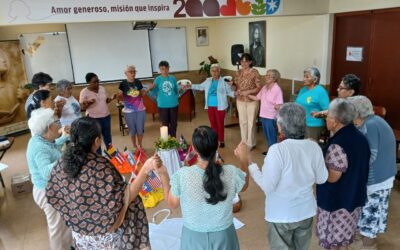
This is the third chronicle of their visit, between November 16 and 23, 2025, during which they shared with the two Vedruna communities of Uruguay: in Chacarita, a neighborhood of Montevideo, and in Melo.
The small group in Uruguay is made up of seven sisters, mostly Uruguayan. The Vedruna charism arrived in the country more than 90 years ago and, throughout its history, has undergone important changes in the way it is put into practice.
The vitality and commitment of the Lay Associates (LA) in the Christian communities and with the neighbors of the neighborhood, as well as in the various needs of the environment, is remarkable. In addition, in one of the communities there is a group of Lay Associates that integrates the alternative health team, made up of about 11 people.
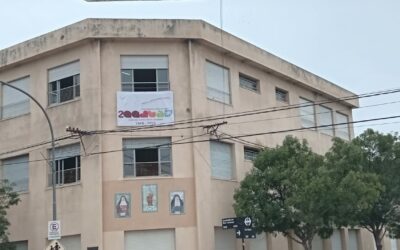
The communities of Chacarita and Melo
There, the sisters perform various tasks within the mission: they work in a private school, substitute in a public school and support a project for minors in need of specific help. In addition, they offer an alternative health service that they develop together with a group of laywomen.
One of the most significant services they provide is the celebration of the liturgy in the Christian community. The lack of priests is especially visible in the Melo area, where the priest must attend to two very large parishes and cannot always reach all the sectors.
Crochet and two-needle knitting are done by the laywomen. Through these activities, training and socialization spaces are created for retired people. The group of lay people who offer alternative health services attends once a month, while the sister responsible for the program receives those who need this accompaniment on a daily basis.
During the visit we participated in the community’s own activities: shared prayer, very pleasant conversations about the reality of the country and, in addition, we enjoyed the delicious empanadas, vegetable pies and roll-ups.
In the two community meetings we had, the participation and reflections made us think that the topics were of interest to them and meaningful to their daily lives.


Uruguay Assembly
The seven sisters from Uruguay were present at the country meeting, and with them we reflected on “Synodality and shared leadership”, seen from the reality of the country. It was a very valuable meeting because, in spite of the responsibilities and work of each sister, we were able to get together and do good group work.
The resonances were:
- Synodality is presented as a path that encourages dreaming, renewal and growth in humanity. It favors a spirituality that deepens interiority and increases sensitivity to others.
- It helps to clarify, question and become aware of the historical moment we are going through, marked by a change of era and a new relationship with God.
- This vision is committed to a mission lived in a synodal key, capable of widening the heart and opening up to new forms of encounter and communion.
- Synodality as a way.
- Renovation and humanization.
- Interiority / spirituality that transforms.
- Sensitivity and closeness to others.
- Awareness of the historical moment and the change of era.
- New relationship with God: integral and ecological spirituality
- Synodal mission that enlarges the heart.


It has caught our attention…
- The mateada is a must for meetings: mate is very important in Uruguayan culture: a traditional drink made with yerba mate, hot water and a bombilla, consumed in a container called porongo or calabaza. It is distinguished by its bitter taste, although it can be sweetened, and is a central part of the country’s social ritual, symbolizing friendship and union when shared in groups. The preparation includes carrying hot water in a thermos and, during consumption, the bombilla is not stirred or cleaned to pass it on to the next person. “In Uruguay, a mateada is not just the act of drinking mate. It is a simple and fraternal meeting place where we gather to share life. The mate, more than a drink, is a gesture of closeness: it is passed from hand to hand, opens the conversation, makes room for listening and creates community. In each mateada a climate of trust and family is woven, where the important thing is not the mate itself, but being together.”
- Festive, celebratory atmosphere: With all the groups we were with, we could perceive their festive atmosphere and “their serene joy”: the taste for sharing not only mate, but something more of their typical food, we saw it in all the celebrations.
- The Uruguayan landscape is beautiful: in fact, here they say, Uruguay onduladito… because the mountains are scarce and not very high, the immense plains where you can see the cows sharing space with sheep and horses, are beautiful. It catches our attention because, until now, we only knew of separate spaces for cows, sheep and horses.
- It was also striking that women in rural areas have long and abundant hair, and when they go out of their environment, they let it down and show it off with pride.
- Sensitivity to addictions. The sensitivity of the Vedruna laywomen and sisters towards the young women in the process of recovery from addictions is remarkable. Every week they visit
the Fazenda , where they bring prepared activities, offer listening spaces, share a snack and participate in the activities of the place. The young women receive them with great joy. - On the edge of the highways: On the way back from Melo, we noticed that families, couples or single people look for a safe parking area and sit and contemplate nature and its enchanting sunset.
This is the third chronicle of this visit. You can now read the other accounts of this trip: