The long awaited February 26, 2026, the exact date of the 200th anniversary of our Congregation Carmelite Sisters of Charity Vedruna, finally arrived. After countless preparations, over many months and from different parts of the world where there is presence of the Vedruna Family, a representation of this gathered in person in Vic to celebrate this special date, giving thanks for these 200 years of history born from the encounter of St. Joaquina with the Good Jesus, the first source of our charism.
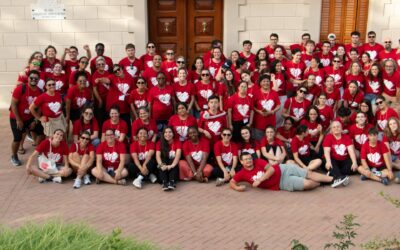
About 300 people gathered in Vic, representing the Vedruna Family in Mission: an international, intergenerational, intercultural presence, accompanied by people and institutions invited for the occasion.
We celebrated together throughout the day, beginning with a solemn Eucharist in the Church of the Mother House, in which more than 350 people joined us online, making us feel their support, affection and prayers. After the Eucharist, in the auditorium of the Vedruna Escorial School, we attended the presentation of the Manso House Project, in which the different teams that participated presented their work and shared their feelings. Then, we moved to the sports center of the same school, where we enjoyed a festive meal, served by the young people of the Vocational Training of Vedruna Gràcia, Barcelona. After sharing not only the meal, but also numerous greetings and congratulations, we moved to the Casa Manso for its official inauguration .
Throughout the day, during all the moments experienced, and wherever one looked, there were smiles full of joy and emotion. The atmosphere shared among sisters, laity, friends and guests was one of enthusiasm and connection; hugs, animated conversations and lively glances were everywhere. The presence of the Good Jesus was felt among all of us, in that simple and joyful fraternity that Joaquina desired so much for her daughters and sons. It was a day of deep celebration, charged with meaning and awareness, and it was a gift to all in attendance to be a part of it.


Solemn Eucharist, Motherhouse Church
The Motherhouse Church opened its doors at ten o’clock in the morning to let in the almost 300 guests invited to the Eucharist. Between greetings and hugs, they settled into the pews in front of the altar. At 10:30 a.m. the live transmission began, thanks to which about 400 people connected online from all corners of the world, thus making the Vedruna Family present in mission. In the chat of the retransmission, they sent us their messages of congratulations, affection and many prayers.
The ceremony began with the opening monition, presented by María Irizar, General Team Advisor. After her, five sisters from India led the way to the altar with a dance dedicated to the occasion, followed by the Sr. General, María Teresa Cuervo, carrying a picture of St. Joaquina who presided over the ceremony, reminding us of her gaze always fixed on the Good Jesus, whom she called with tenderness and trust throughout her life.


Then, the entrance procession walked down the aisle towards the altar: Maria Gracia Gil, Provincial Sister of Europe , carrying the Bible; and Sisters Dolors Garcia, Stella Maris Mansilla, Maggie D’Costa and Nuria Juvanteny, carrying banners with the continents where there is Vedruna presence and the dates of arrival in each one. Then, the eight priests, friends of the family, who concelebrated, together with Msgr. Bishop of Vic, Romà Casanova, and H.E.R.H. Cardinal Seán O’Malley.


Four of the languages spoken in the Family were present in the liturgy: Catalan, Spanish, English and French. The readings were shared by Sisters Rita Aragón, Marguerite Mbima, Puy Araujo and Dolly Michael. We heard the petitions from the voice of Sister Mª Dolors Bosch, and Gonzalo Embid.


The ceremony was simple, yet solemn and heartfelt. All the songs and the psalm were performed by Ain Karem, who filled the church with their beauty. The guests listened to every word shared with attention and emotion.
One of the highlights was the presentation of the offerings, which included the plans of the Casa Manso project and a miniature of the building, among other symbols to represent the sisters, the common house and the three spirits of the charism (educate, heal and liberate). They were carried by sisters Adoración Pujadas, Lucy Mathara, Carmen Carrandi and Carme Molist, María Inés García and Sisita Fiol, together with Mamen Barrena, Minerva Peña, David Frutos and Josep Closa . Another highlight was the adoration of the sisters of India during the amen after the doxology.


For his part, Cardinal Séan O’Malley gave us a beautiful homily, in which he recalled the beginnings of Joaquina approaching Capuchins and St. Francis of Assisi, spoke of his bond with our family in numerous mission spaces that made him know and admire the Vedruna charism; and celebrated the 200 years of our Family with the deep affection of a friendship of decades.


The final touch was the interpretation of the hymn of the Bicentennial of the Vedruna Education Foundation, sung by students of the Colegio Nuestra Señora del Carmen, Toledo. All the guests joined him with their hearts and clapped their hands to the sound of the guitar: it was the perfect way to close the Eucharistic celebration.


Presentation of the Casa Manso Project
In the auditorium of the Vedruna Escorial School, next to the church of the Motherhouse, María José Meira, advisor to the General Team, led the presentation of the various teams that have participated in the process of rehabilitating the Manso House.
The first intervention was by Sister Mabel Burgell, a great connoisseur of the history of the Congregation, the life of Joaquina, and the Manso Escorial. With her characteristic eloquence and depth, she shared the origins of the rehabilitation project: it all began with the concern of the sisters of the community that lived in the Manso Escorial to preserve the house. Their proposal was presented to the previous General Team, whom Mabel thanked for accepting it and giving it impetus, and the current General Team took over, until it materialized in the project we see today. Mabel mentioned in her speech Sister Imma Bonada, recently deceased, who was part of this initiative from the beginning, and invited us to keep her in mind.
María José then invited the Espacio Manso Commission to share their experience throughout the process, and took up the memory of Imma Bonada by inviting a minute of silence for her. Afterwards, Alicia Avis, Virginia Félix, Mamen Barrena and Ramón Rial took their seats, to share through a dialogue the path lived by the commission. Virginia spoke from a charismatic approach, highlighting the thread that links the house’s past with the present; Ramón provided data on the historical context in which Joaquina’s life took place and how it is reflected in the house; Mamen highlighted Joaquina’s presence throughout the project.


After them, Sister Herminia Álvarez, Administrator and Bursar General, introduced the architectural rehabilitation team. Miguel Ángel Santibáñez, consultant architect of the Congregation, dedicated words of gratitude to his colleagues and the sisters; Santi Casas, in the facultative direction together with Toni Casas, explained how they worked to make an integral intervention to the house, garden and facilities, that would respond to the two uses of the building: as a museum to show the legacy of Joaquina de Vedruna, but also as a house where a community of sisters will continue to live. Finally, Nuria Matencio shared some of the difficulties encountered along the way: as a technical architect, she was in charge of facing all the surprises and unforeseen events of the work, but in her words there was joy for having overcome them.
Finally, Raimon Casals and Marc Saborit shared from the design approach of the museographic project. They highlighted the easy, frank, direct and open relationship with the Congregation and the Commission, pointing out that the good result is the fruit of this harmonious work. They pointed out how the task of explaining the life of someone from the 19th century in the 21st century was a challenge and at the same time a great possibility, and how this dialogue in time is a central part of the tour of the Casa Manso. They also named some of the transversal axes of their proposal: participation, the living space, Joaquina’s letters or the furniture.


The presentation was enlivened at the beginning and at the end with the musical performance of the 6th grade students of the Vedruna Escorial School. At the beginning of the event, they performed “Cançó a la Santa Madre”, a song written by Mabel Burgell more than five decades ago; and ended with the hopeful song entitled “Fins Ará”.
Festive meal
After so much excitement and information, we headed to the school sports center, where the festive meal awaited us. We enjoyed sharing as a family around the table: the conversations in every corner were lively and cheerful.
The service was carried out by the young people of the Gràcia FP School in Barcelona: it was a joy to count on their careful and attentive care.
Inauguration of Casa Manso
After lunch, we headed from the Casa Madre to the Casa Manso. Upon arrival, Sister General Maria Teresa Cuervo shared some words to officially inaugurate the Casa Manso: in them we could feel the emotion for this historic event, for the deep meaning of this place for our family, and for the illusion of seeing it transformed after a long process.
Raimon Casals then explained the meaning of the mast at the entrance: a novelty in the space, of imposing height divided into three fragments, it has a large “J” at the top. At its top is a light that, when lit, points to what was Joaquina’s bedroom, and symbolizes the Vedruna charism in the world, Vic being a beacon of reference for our entire Family.
At the new entrance of Casa Manso, which is made through a door that has been recovered in this rehabilitation after being walled up, there is a new plaque with a relief of Joaquina. It is a work of Teresa Guerrero and Javier Martinez, who have prepared especially for this inauguration. The image shows a young Joaquina and the three spirits, educate, heal and liberate, around her. In her hands she carries a burning flame, symbolizing the charisma that is still alive today, two hundred years later. Being made of bronze, as visitors pass by and touch the flame, it will remain bright as the living fire it represents.
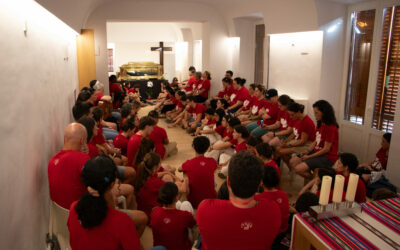
After the various presentations, the guests entered in groups to tour the House as visitors will do in the future, passing through the kitchen, Joaquina’s room, her cell, the attic… but also the chapel, a new space where the urn with the remains of Joaquina is located, and where the stained glass windows that used to be in the windows of the building are located. On leaving, many people were moved by the visit, and spoke of the atmosphere of recollection and emotion that permeated all the spaces.
“Casa Manso. Joaquina de Vedruna”, after this official inauguration on this special day, will continue under construction, receiving the final touches, in view of its next opening to the public.