The new edition of Dialogue and Encounter magazine is now available. This issue, entitled Peace, the fruit of justiceurges us to look squarely at the root causes of armed conflict and to commit ourselves actively to building a culture of peace. The complete magazine can be downloaded by clicking on the following link, choosing your language:
Today we highlight an article from the Vedruna in the world section , written by Mitsue Shirahama, ccv. After World War II, Japan began a path toward peace and democracy. The Church, including the Vedruna family, has promoted the defense of Article 9, the antimilitarist struggle and the commitment to justice and peace.
A bit of history
After World War II, Japan surrendered in August 1945 with great humiliation after the destruction of two major cities, Hiroshima and Nagasaki, due to the dropping of atomic bombs (the first of its kind in the history of mankind). With this, military rule in Japan, which had lasted for a long time, invading and causing great damage to neighboring countries, ended and the creation of a more democratic government began.
At this time, under the demand and surveillance of the United States, a new Constitution was drafted, which included the absolute rejection of armament and war. Article 9 of the Constitution explicitly forbids the creation of an army and the use of armaments for war or invasion of other countries. However, today, almost 80 years after the end of World War II, Japan remains subordinate to the United States and seeks to remain under its wing as a major military power. In this context, the Japanese government is seeking to amend Article 9 in order to become an active military ally of the United States.
The Church in Japan, after the creation of the National Commission for Justice and Peace in the 1970s, linked to the Vatican, began a process of awareness-raising among Christians. However, this was a slow process, since many Christians had a spirituality rooted in the Church for centuries, focused exclusively on the salvation of souls, leaving aside the human and social dimension. It took many years for the Christian community to grow in this new awareness. Over time, the Church in Japan has developed a more critical vision in the face of social injustices and in defense of human rights. In our Vedruna Province, we have followed a similar process. Before, we could not even talk about social and political problems or speak out in favor of Article 9 of the Japanese Constitution, which was under threat. Today, we have a more critical view and are more sensitive to social problems, which allows us to speak calmly about these issues.


Our commitment to peace
We summarize our commitment to peace from four main areas:
1. Fight against the construction of a U.S. military base on the island of Okinawa.
Okinawa is an island located southeast of the Japanese archipelago, about 1,550 km from Tokyo. At the end of the war, it was occupied by the United States and, in 1972, returned to Japan. Since 2010, we have participated in various initiatives promoted by the National Conference of Women Religious of Japan, such as:
- Collection of signatures against the construction of a U.S. military base in Okinawa.
- Demonstrations by religious and Christians in front of the Government Palace in Tokyo.
- Participation in the protests organized by the local population of Okinawa against the construction in Henoko.
- Visits to the construction site and active participation in the resistance campaign.
- Prayers and follow up on the news about the situation in Okinawa.
- Participation in the celebration of June 23, commemorating the massacre suffered by the Okinawan population during the war.
- Promotion of peace education in our Aitoku school, with visits to Hiroshima and Nagasaki and meetings between students from different schools on world peace.
- Participation in the “Day of Peace”, organized annually in August by the Church in Japan.
2. Defense of Article 9 of the Japanese Constitution
When the government began to consider amending the Constitution, especially Article 9, small protest groups emerged across the country, such as “Kyūjō o Mamoru Kai” (“Group in Defense of Article 9”).
- In the Catholic Church, “Peace Nine” was formed, coordinated by Bishop Matsuura Goro, with the participation of 3,000 Catholics in 800 active groups.
- These groups are organized at the parish and regional levels, exchange information on the situation in the country and the world, and participate in national meetings of the National Justice and Peace Commission.
3. Support for victims of current conflicts
The Russian invasion of Ukraine and the situation in Palestine are of deep concern to us. In the Shimada community, we have supported the exhibition of drawings by Ukrainian children affected by the war. Each community dedicates one day a week to prayer for Ukraine and Palestine and offers small donations to the suffering people.
4. Movement against nuclear weapons
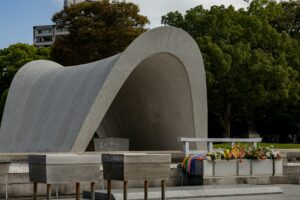
Japan is the only country to have experienced the devastating force of the atomic bomb. The survivors of Hiroshima and Nagasaki have fought tirelessly against nuclear weapons and recently received the Nobel Peace Prize. Despite the lack of support from the Japanese government, their testimony has inspired new generations.
For us, the Vedruna Sisters, their example has left a deep mark on our hearts. We feel called to continue to struggle for peace, joining those who work for a world free of war and violence.
Sr. Mitsue Shirahama, ccv
The complete magazine, Dialogue and Encounter, Peace, the Fruit of Justice, can be downloaded by clicking on the following link, choosing the language of your choice: